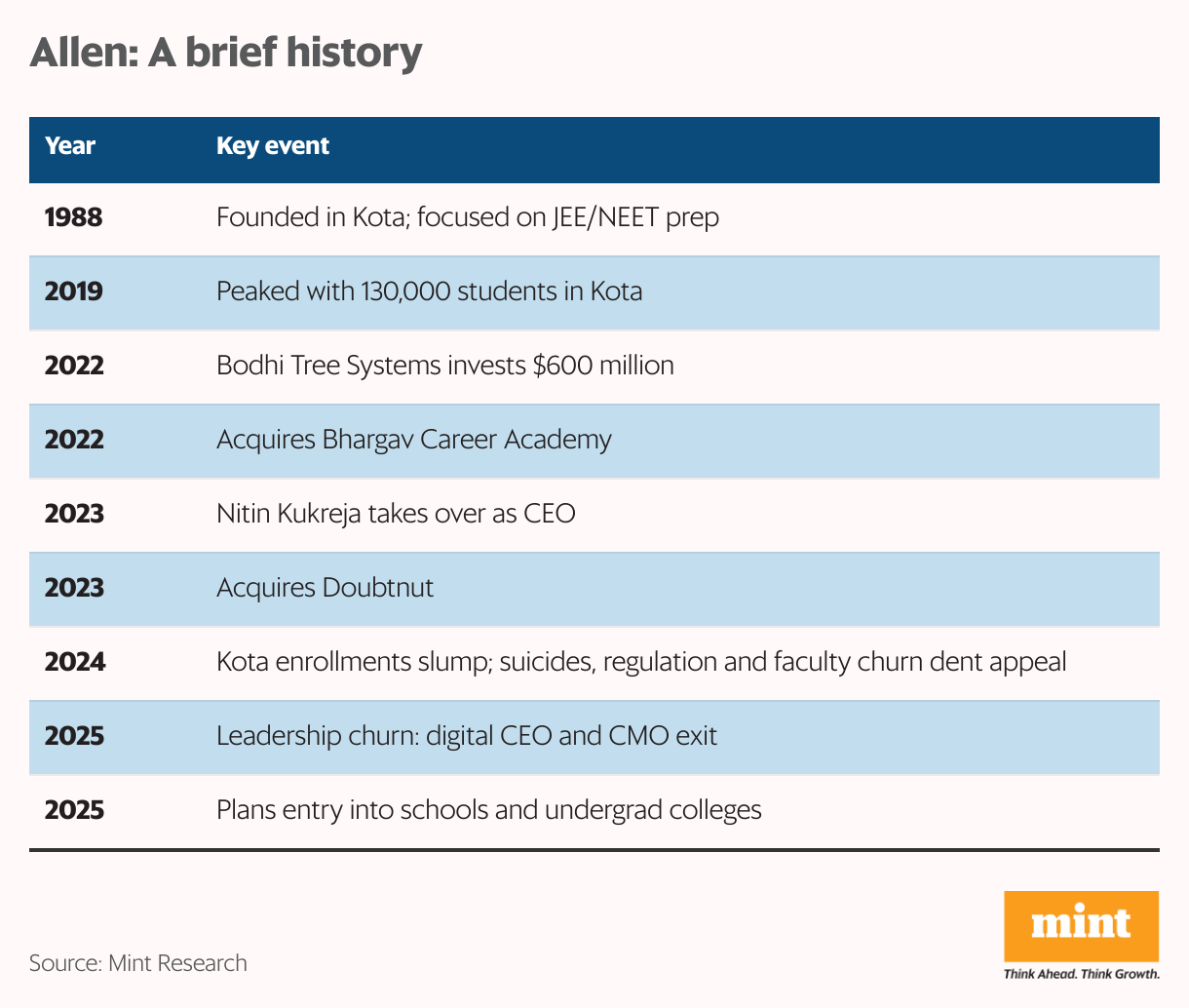
Founded by Rajesh Maheshwari in 1988, in a rented room in Vallabh Bari area of this Rajasthan city, the education empire boomed, and Kota itself became synonymous with India’s test preparation (test-prep) dream.
The pandemic in 2020 broke that rhythm. Enrollments crashed to nearly a quarter, revenues tumbled, and rivals poached faculty. Yet by 2021–22, pent-up demand pulled students back, and Allen’s footfalls once again crossed 100,000. To many, the Kota fortress looked steady again.
Bodhi Tree, a fund with a reputation for picking winners, poured a staggering $600 million into Allen in 2022.
But beneath the surface, the test-prep order had shifted. In June 2024, Nitin Kukreja, Allen’s CEO, told the faculty that enrollments in Kota had once again plunged, from 131,000 the year before to just 81,000 in 2024, a nearly 40% drop, Mint had reported back then.
Online upstarts, hybrid models, restless teachers, and a city scarred by rising student suicides were eroding the very foundation of Kota’s dominance—and with it, the crown jewel of Allen Career Institute.
Today, the company is at a crossroads, compelled to chart a new path beyond its hallowed test-prep halls.
Under the leadership of Kukreja, the former Star Sports CEO, the company has been attempting a transformation over the last three years—from brick and mortar coaching centres to an education conglomerate with a strong digital backbone.
But that dream has been riddled with challenges. Slow growth, a flurry of top-level exits, and a lacklustre digital adoption rate have raised a fundamental question: Can Allen reinvent itself, or will it be a casualty of the very digital wave it is trying to ride?
Out-of-Kota strategy
For over 35 years, Allen Career Institute has been synonymous with rigorous test preparation, training students to crack the Joint Entrance Examination (JEE) and the National Eligibility cum Entrance Test (NEET). A good score in these examinations is a ticket to India’s top engineering and medical colleges, respectively.
But the golden era of Kota, the bedrock of Allen’s massive legacy, is arguably over—with frequent government crackdowns—because of suicides and building law violations. Subpar placements in the tech industry, and increasing layoffs, have only added to the uncertainty in the test-prep market.
In fact, peers diversifying beyond their traditional markets are also excluding Kota from their plans.
View Full Image
Ujjwal Singh, founder and CEO of Sri Chaitanya’s digital test prep venture, Infinity Learn, told Mint that while the company has been expanding from its southern stronghold into northern states, its Rajasthan presence is concentrated in Jaipur and Sikar. “We have been considering an entry into Kota over the past year, but our research shows the city is shrinking as a market for both new and existing players. Our north India foray will focus on source markets, cities where students come from, rather than destination hubs like Kota,” Singh said.
Allen, therefore, has been forced to diversify.
According to two industry executives, Allen is pursuing an aggressive entry into K-12 schooling and higher education, a radical strategic shift.
“The company is looking for a land parcel of two-three acres in top metros, and the plan is to enter the schooling ecosystem with the premium International Baccalaureate (IB) curriculum,” one of the executives, who didn’t want to be identified, said.
To lead this charge, the company has hired Vishnu Karthik, the former CEO of ‘Xperiential Learning Systems’ at The Heritage Group of Schools in the National Capital Region. Allen did not confirm Karthik’s appointment.
Allen’s ambition doesn’t stop at schools. The company is also exploring a foray into undergraduate degree colleges, although the details aren’t known yet.
“The high-stakes bet to become a full-fledged education ecosystem is fuelled by a simple business rationale: 10% are rankers, 90% are bankers,” said a venture investor, who has evaluated and made investments in consumer-facing education businesses. “90% still believe in the Allen brand, and it is a good strategy to use that funnel to fuel their higher education segment.”
Allen confirmed the schooling and higher education foray but did not share details. Queries sent to Bodhi Tree did not elicit a response.
The bet to become a full-fledged education ecosystem is fuelled by a simple rationale: 10% are rankers, 90% are bankers.
— A venture investor
The latest move is the third prong of a broader plan being pursued over the past three years. The first was taking the brand directly to students in new cities, instead of forcing them to move to the coaching hub of Kota. In the past year alone, Allen has entered over 20 cities. This expansion has brought in over 100,000 new students, partly cushioning the hit from Kota’s shrinking enrollments, Kukreja told Mint in an interview.
The second, and most critical strategy, is a push into the digital space. The company’s online arm is called Allen Digital.
The digital dilemma
The physical expansion, and a push into schools, are rooted in Allen’s existing playbook. But the digital foray requires a complete leap of faith: a full-scale transformation of a traditional family-led business. Apart from Rajesh Maheshwari, brothers Brajesh Maheshwari, Govind Maheshwari and Naveen Maheshwari were also part of the business.
For a company that has taken on a $600 million investment, a tech-led strategy is also expected to command a much higher valuation when the company eventually lists on the bourses, an inevitability given the responsibility of providing investors with an exit.
“In education, valuations differ sharply: offline models get one kind of number, but digital platforms command a premium,” said an investment banker, who has been valuing tech-based companies. The person didn’t want to be identified. “Test prep has seen both waves. First everything went online, then back offline. But the eventual winners will be those with strong digital offerings. Investors want Allen positioned at the front of that curve,” the banker added.
The journey, thus far, has been rocky.
Allen Digital has enrolled 500,000 paying students over the past 15 months, including both online and offline. 45,000 of them are purely online, the company stated.
Online growth has been slow, especially when benchmarked against rivals who have scaled into the millions.
Case in point, Noida-based Physics Wallah. Its online paid orders rose to 2.4 million in 2023 from 0.85 million in the previous year, according to a YourStory report. The edtech firm began as a YouTube channel set up by star teacher Alakh Pandey.
The reasons for slow adoption largely boil down to poor timing and pricing.
Allen Digital was launched way back in June 2022, when the pandemic-fuelled ed-tech boom was coming to a screeching halt. “Customer expectations around edtech were at all time low. To come in and build trust in the category once again, to say that this is one place where you can really get your learning done, was a harder climb than we thought,” said Kukreja.

View Full Image
While its closest rival in the online space, Physics Wallah, swears by selling courses for as little as ₹4,500, a comparable Allen IIT JEE course can cost upwards of ₹90,000.
“For some competitors, customer acquisition costs are close to zero due to their tech DNA, like in the case of Physics Wallah, which has a large YouTube presence. Unless Allen can build a similarly low-cost channel, it will have to keep pricing between ₹30,000 and ₹50,000 to sustain margins,” said an industry advisor, who spoke to Mint on the condition of anonymity.
Kukreja declined to comment on the competition’s strategy. However, he said that Allen has been able to place over 100 students into IITs, with its pure online delivery modules, hinting at its value proposition.
While that’s a classic debate of quality over quantity, in the near term, it has resulted in Allen’s slow growth.
“Kota has always been central to Allen’s profitability. Earlier, even if the non-Kota business was a bit wobbly, the city was strong enough to generate steady cash flows and carry the company forward. But with falling enrollments and the shadow of student suicides, that core engine has been hit,” said the industry advisor quoted above, highlighting the headwinds the sector is now facing.
Since Allen operated as a partnership firm until 2021-22, year-on-year figures aren’t directly comparable. For 2022-23, revenue from operations stood at ₹2,277 crore. In 2023-24, revenue rose 42% to ₹3,244.7 crore, while profit fell 44% to ₹135.9 crore.
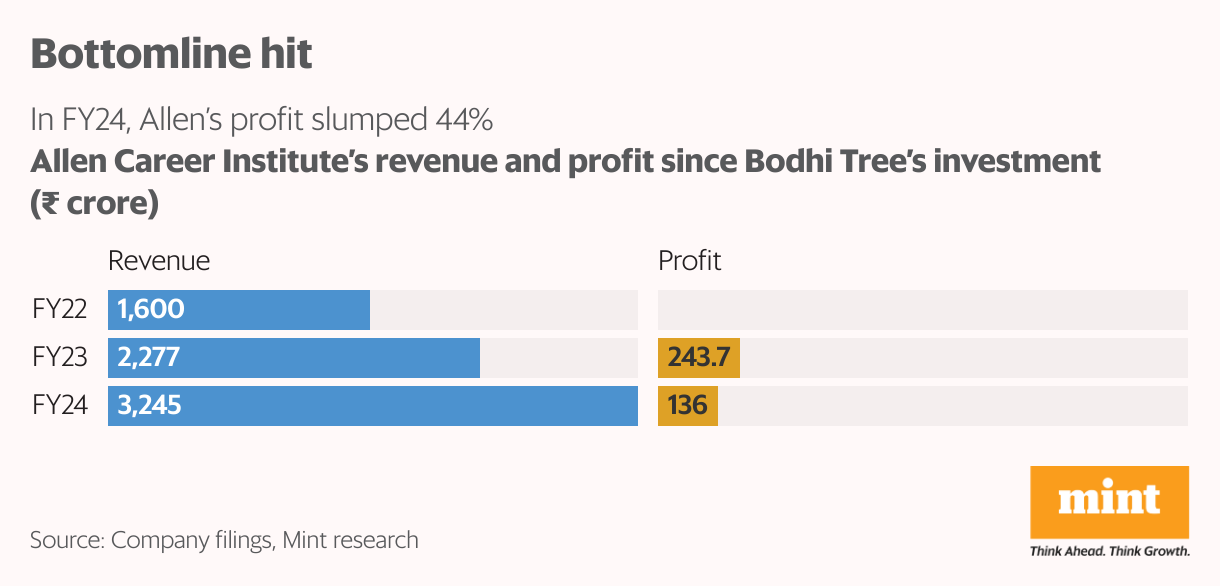
While Kukreja claims that Allen has generated two-fold revenue growth in four years, this falls short of private equity expectations. “From a private equity lens, the thumb rule is a 25% dollar IRR (internal rate of return)—which means the business has to grow 3x in five years,” said the advisor.
Kukreja said the slow growth is a conscious choice.
“If I look back at the last three years, the fundamentals are in place and the business is in a much healthier state. Could we have grown faster? Maybe,” he said. “Maybe, we could have launched many more centres outside, maybe moved faster on digital. But we were always watchful—to do it with the right things in place. Especially when you see what has happened to the landscape outside.”
Byju’s, once India’s most valued edtech startup, rapidly declined into a sea of lawsuits, a result of reckless acquisitions, fast expansion, and a lack of financial discipline.
Star exits
Allen Digital’s problems were exacerbated by two high-profile leadership exits. The most telling sign of trouble came with the departure of its first-ever CEO, Abha Maheshwari. A former Meta executive, Maheshwari was hired two years ago to infuse a tech-first DNA into the traditional business.
“She was not making much headway… There were organizational complexities and cultural disconnects between the legacy Allen and digital teams,” said the industry advisor quoted above.
Her exit was closely followed by that of Apoorv Sharma, the chief marketing officer who joined from Apple but quit in May this year, just 1.5 years into his tenure.
Kukreja confirmed the two exits but declined to cite reasons.
“Abha has done a fantastic job in terms of building up the platform for us, and so has Apoorv,” said Kukreja. “The great thing is that we have been able to attract talent. We have got teams from Google, Meta, Apple, Flipkart, Kotak…you name it. In a large organization like ours, you will have some management churn,” he added.
The fix-it plan
Faced with a leadership exodus, a floundering digital strategy, and a weak core business, the Star Sports veteran is not deterred. Kukreja said that the company’s profit fall in 2023-24 was for necessary investments in a long-term play.
While Allen is doubling down on its physical expansion in new cities, it is also growing flexible on pricing. “At the lowest tier, a ₹5,000 test series is available. Full online packages, with features like doubt resolution, start at around ₹30,000, while hybrid models in smaller cities are priced closer to ₹50,000,” Kukreja said.

View Full Image
Meanwhile, the company is trying to fix the tech gap through inorganic moves. In December 2023, it acquired Doubtnut, an AI-powered doubt-solving platform.
The acquisition gave Allen immediate access to a robust tech stack that it had struggled to build in-house. Kukreja said he is open to more such buys.
Last December, The Economic Times reported that Allen held talks to acquire edtech firm Unacademy, which signalled a larger ambition to consolidate the market and gain a bigger digital foothold. Unacademy, in 2022, was valued at $3.4 billion. The acquisition has, however, fallen through.
Internally, the company is attempting to shed its family-run image (the Maheshwaris are still on the board) and embrace a corporate structure. Like many new age startups, they are incorporating new practices with formal notice periods, severance, and performance evaluations, Kukreja said. Most interestingly, it has introduced employee stock ownership plans (Esops), starting with the non-teaching staff, and slowly extending the benefit to long-term teaching employees.
But creating a full-stack education company still remains a tricky business. Allen will have to compete with not just edtech startups but also strong regional players.
The Chaitanya Group, Hyderabad-based, has successfully expanded into schools but has done so with a cautious, regional focus. Then there is Amity, which built a brand by starting from higher education and then expanded into other segments like K-12 schools. However, its model is more akin to a private university.
The closest parallel to Allen’s ambition is Physics Wallah, which also started as a test-prep brand and is now attempting to create a full education ecosystem. While Physics Wallah has the funding and a passionate community, it has recently slipped into losses.
The closest parallel to Allen’s ambition is Physics Wallah, which also started as a test-prep brand and is now attempting to create a full education ecosystem.
Anupam Shukla, partner at Pioneer Legal, who specialises in private equity deals within education, noted that much of the expansion phase in the coaching industry is over. What was once a period of flux—when unorganized tuition shifted to professional coaching systems—has now stabilised, leaving fewer opportunities for rapid scale-up, he said. In schools, any new player, even with a large legacy, would face hurdles competing with entrenched players who already dominate catchment areas and student pipelines, he added.
Allen, nonetheless, has the advantage of a huge war chest, thanks to Bodhi Tree.
Kukreja believes that the company’s record in delivering outcomes will ultimately differentiate it in a market now skeptical of flashy growth and big promises.
“4,500 Allen students cracked IIT admissions this year,” he claimed. “Just 1,100 were from Kota; the rest from other cities.”
Key Takeaways
- The test-prep market in Kota is struggling.
- Online upstarts, hybrid models, and a city scarred by rising student suicides have eroded its dominance.
- Allen, which made Kota the hub for test coaching, is, therefore, struggling.
- The company is trying to diversify into digital education, schools and higher education.
- Creating a full-stack education company is a tricky business.
- Allen will have to compete with not just edtech startups but also regional players who dominate catchment areas.
- The company is attempting to shed its family-run image and embrace a corporate structure.
- It has introduced Esops, starting with the non-teaching staff.
- Allen’s CEO believes that the company’s record in delivering outcomes will ultimately differentiate it in a market now skeptical of big promises.